The Bible Through Oriental Eyes by Merja Merras and Paul Nadim Tarazi

For centuries, the Bible has been interpreted both through scientific methods and through the teachings of the Church. Both approaches are consistent with Western thought. The problems encountered by Western exegesis may not actually be problems in an Oriental context, but rather quite normal aspects of life at that time.

The Hebrew of the Old Testament is the key for understanding the Bible. Hebrew is related to the Arabic language in use today, and one can find points of connection between it and the language and culture of the Bible. Western exegesis has taken this perspective into account only to a very limited extent. Therefore, it might be helpful to approach the Bible through Eastern lenses, while keeping in mind that the Bible was not written for us—though certainly for our benefit as well—but for entirely different people in an entirely different culture.

We are accustomed to asking: What does the Bible say about this specific matter? But if we ask the question: What does the Bible say? Then we must set aside our familiar preconceptions about the text and focus solely on the words that make up the Bible. Humanity has no other knowledge of the Almighty God than the Bible. One has to seek answers from it, not from the structures the human intelligence has created.

Merja Merras is an adjunct professor of Eastern Early Church History in Finland. Professor Paul Nadim Tarazi was born in Palestine and taught Biblical Studies in the United States and Lebanon for over forty years. He has published in English a seven-volume Introduction to the Bible series, on which this book is based.

ISBN 978-1-60191-072-1

BUY ON AMAZON

Standing Before God by Raymond Acker

Standing Before God follows the order of the Liturgy itself. From the opening blessing to the dismissal, it traces what God does at each turn and what is required of those who remain in His presence: to stand, to hear, to keep silence, to offer, to receive, and to go. Those who enter the Liturgy do not come as observers or evaluators. They are placed before the King and bound by the terms of His commonwealth. The Liturgy does not wait for their assent. It acts, and to remain present is already to accept responsibility under His Instruction.

First delivered as a five-part teaching series in the context of the Divine Liturgy, this short volume speaks with the same plainness as the worship it serves. It offers no reflection, no interpretation, and no reassurance. It offers clarity about where the faithful stand and under whose authority their lives are ordered—an authority that does not recede when the assembly disperses, but abides.

For catechumens, inquirers, and those long within the Church alike, Standing Before God returns the reader to the Liturgy with sobriety, so that what has been given there may be lived under everywhere.

ISBN 978-1-60191-070-7

BUY ON AMAZON

The Eucharist: Grammar of Thanksgiving by Marc Philip Boulos

In The Eucharist: Grammar of Thanksgiving, Marc Philip Boulos offers a fierce and sweeping hearing of Scripture through the shared grammar of Hebrew, Greek, Arabic, and the Abrahamic scrolls. Moving from Luke 9:1–17 to Deuteronomy, from Ezekiel’s dry bones to the Qurʾanic wilderness, from the manna to the feeding of the five thousand, this book argues that the Eucharist is not a doctrine to be explained or a ritual to be owned. It is thanksgiving: God’s provision received under command and given for the life of the neighbor.

Against every tower human beings build—nation, tribe, ideology, institution, theology, and self—the book insists on one uncompromising claim: nothing belongs to us. Not the land, not the covenant, not the bread, not the word, not the neighbor, not even the future. Everything is received from the hand of God.

At the center stands the table in the wilderness, where scarcity is exposed as unbelief and the bread of God’s word is broken for all. To eat eucharistically is to hear, receive, give thanks, and be bound into the bundle of the living.

The final question is the archangel’s question: Who is like God?

The answer is the beginning of worship: No one.

ISBN 978-1-60191-069-1

BUY ON AMAZON

Seen and Unseen: The Earth as the Ground of Testing by Marc Philip Boulos

In Seen and Unseen, Marc Philip Boulos hears the twelve verses of Luke 8:41–56, the raising of Jairus’s daughter and the healing of the hemorrhaging woman, through the consonantal triliteral roots that bind the Hebrew Bible, the Greek New Testament, and the Qurʾan into a single grammar of submission. Continuing the lexical method opened in Rise, Andalus, this second volume refuses every theological scaffold that has been imposed on the text and works instead in the lineage of the ʿulamāʾ of al-Andalus, who knew six centuries before the modern academy that the Hebrew of the Bible cannot be heard apart from the Arabic of the Qurʾan, and that the triliteral root governs both.

The result is not interpretation but hearing. The seed is choked by the crowd of thorns. The yaḥid stands stripped before al-wāḥid. The daughter of Israel approaches in deference, where the disciple Judas approaches to lay claim. The bones in Ezekiel are dried up, and the Lord asks who can give them breath. Lazarus emerges from the cave of robbers, and the cave, it turns out, is the temple. Across these thresholds Boulos traces the same itinerary: the suffocation of instruction by the religious crowd, the transience of every human settlement, the surplus of grace that falls to the empty hand alone.

The earth in the title is not landscape. It is test. Ground beneath the feet of a transient people, the soil into which the seed is sown and from which the only daughter is raised. Each chapter is a verse, each verse a riddle, each riddle a mašal that overrules dynasty, possession, and self-reference. Seen and Unseen does not domesticate the text. It silences the noise so that the Master’s voice can be heard, and breath can return.

ISBN 978-1-60191-068-4

BUY ON AMAZON

The Madness of the Shepherd by Matthew Franklin Cooper

Kosta Levan Khetagurov (1859–1906) remains the towering figure of Ossetian literature and one of the most significant poets of the late Russian Empire. Writing in both Ossetian and Russian, he gave voice to the material suffering and political aspirations of a people caught between imperial exploitation and internal complacency… and did so with a range that moves from prophetic fury to black-comic fable.

In The Madness of the Shepherd, Matthew Franklin Cooper applies the literary-functionalist methods of Trubetskoi and Jakobson to Khetagurov’s lexical choices in both languages. Tracing key Ossetian terms (like фыййау ‘shepherd,’ æгъдау ‘honour,’ and зарæг ‘song’) back through their Iranian roots to the Avestā and the Nart Sagas, and examining how Arabic and Qurʾānic resonances inform the Russian-language epic Fatima, Cooper places Khetagurov in conversation with Ferdowsī, Gogol, Lu Xun, José Martí, Rubén Darío, and the Palestinian poets of exile. What emerges is a portrait of a poet whose shepherd is at once messiah, satirical fool, and rallying cry.

“Cooper’s style is fresh and singular. With prophetic incision, he draws the reader into the living world of a 19th-century Caucasian poet… and then, without breaking stride, turns the same lexicographic blade on the present, holding his reader to account under the burden of current events in West Asia. Khetagurov’s words, in Cooper’s hands, are not museum pieces but living seeds planted directly into the complacencies of our own time.”

—Fr. Marc Boulos, rector of St. Elizabeth OCA (St. Paul, MN), host of The Bible as Literature Podcast, author of Rise, Andalus

ISBN 978-1-60191-067-7

BUY ON AMAZON

Rise Andalus by Marc Philip Boulos

Rise, Andalus: The Fall of Imperial Harlotry argues that the destruction of the shared Semitic intellectual tradition-rooted in triliteral grammar, comparative philology, and cooperative scriptural study-was the direct consequence of European imperial ascendancy after 1492. Through close linguistic analysis of Hebrew, Arabic, and Greek roots across the Bible and Qurʾan, Marc Philip Boulos contends that the three Abrahamic scrolls function as a unified act of resistance against empire. The texts confront imperial systems not through philosophical abstraction, theology, or moral law but by exposing their hollowness and recalling humanity to a scriptural grammar of submission, difference, and encounter.

The book situates this argument within a historical arc stretching from the massacres at Acre and the Third Crusade, through the fall of Granada and the Alhambra Decree, to the Gaza Genocide of 2025. In each case, imperial violence is directed not only against peoples but against Scripture itself: an attempt to erase the Semitic memory embedded in consonantal language, prophetic confrontation, and the wilderness tradition.

Yet, the scattering of al-Andalus had a positive impact: its legacy of shared Semitic scholarship, inter-religious coexistence, shared living, and borderless table fellowship was carried into the Ottoman lands. There, diverse communities continued to trade, study, and live together under God's proprietorship, demonstrating that another way of life-Pauline Table Fellowship-was possible.

Against this backdrop, Boulos emphasizes that true unity arises not from enforced sameness or ideological systems but from accepting divinely ordained difference and relinquishing self-reference. Drawing on the example of al-Andalus, where Jewish and Muslim scholars practiced cooperative philology, he highlights a model of textual interaction that resists domination while fostering shared submission to the Abrahamic word.

Ultimately, Rise, Andalus frames the Qurʾan and the Bible as unified enduring witnesses against imperial domination and as pathways back to Jesus Christ through the shared Semitic roots of his Gospel. The book challenges Judeo-Christian imperial and pagan monoculture, while reclaiming the consonantal Judeo-Arabic grammar of Scripture as the living site of interfaith encounter, resistance, and hope.

BUY ON AMAZON

Jie Jing Shuo Wen: A Comparative Sinitic-Semitic Lexicography, Volume One by Matthew Franklin Cooper

Jie Jing Shuo Wen: A Comparative Sinitic-Semitic Lexicography, Volume One by Matthew Franklin Cooper proposes a bold and methodologically disciplined reexamination of early Chinese Christian texts through the lens of comparative Semitic linguistics. Centered on the seventh-century mission of Aluoben and the linguistic world that made that mission intelligible, the book argues that certain classical Chinese terms used in early Christian discourse were not merely approximate translations of Syriac or Hebrew concepts but were selected because of deep functional and conceptual parallels between Sinitic characters and Semitic roots.

Drawing heavily on the Shuowen jiezi and the Erya, Cooper treats Chinese characters not as static ideograms but as semantic fields shaped by sound, usage, and ritual function. These fields are then placed into sustained comparison with Semitic triliteral roots, particularly from Hebrew and Syriac, allowing patterns of usage to emerge that transcend surface-level translation. For example, characters associated with hearing, writing, authority, instruction, and transmission are examined alongside Semitic roots such as ש-מ-ע (to hear/obey) and כ-ת-ב (to write/decree), revealing shared assumptions about how truth is received, preserved, and enacted.

The book situates this lexicographic work within the historical and literary context of the Tang dynasty, where religious discourse unfolded in a multilingual, multicultural environment shaped by Buddhism, Daoism, Confucianism, and West Asian Christianity. Rather than framing Aluoben’s project as a simple case of cultural accommodation, Cooper presents it as an intellectually rigorous interaction with Chinese linguistic categories that were already capable of bearing this weight. In this reading, early Chinese Christianity emerges not as a foreign imposition but as a dialogical tradition grounded in shared structures of literary function.

Volume One lays the theoretical and methodological foundation for this approach. It establishes principles for cross-linguistic comparison, cautions against anachronistic readings, and demonstrates how lexicography can function as a form of historical study. By focusing on words rather than doctrines, the book shows how concepts such as revelation, obedience, inscription, and teaching were negotiated at the level of language itself.

Ultimately, Jie Jing Shuo Wen invites readers to reconsider how sacred texts travel across cultures. It challenges modern assumptions about translation, arguing that fidelity is not achieved through lexical equivalence alone but through alignment of conceptual worlds. This first volume opens a path for future work that treats Sinitic and Semitic traditions not as isolated systems but as participants in a shared human effort to articulate function, authority, and the divine.

ISBN 978-1-60191-062-2

BUY ON AMAZON

In the Houses of the Poor by Matthew Franklin Cooper

A continuation of the fragmentary Gothic Skeireins, In the Houses of the Poor extends its Antiochian exegetical trajectory on John’s Gospel into contemporary historical and political contexts. Throughout, Matthew Franklin Cooper develops a biblical critique of debt-lording, slavery, and justice by setting biblical teaching against both Roman imperial practice and modern systems of oppression.

He begins with the Jubilee legislation of Leviticus 25 and Isaiah 61, rooted in the ancient Near Eastern “clean slate” proclamations in which debts were annulled and bond-servants restored. In Scripture, however, Jubilee is reoriented as divine command: remission is not charity but the very definition of God’s justice—liberating the debtor, restoring the poor, and granting even the land its rest.

The prophets radicalize this practice, condemning those who moralize debt and exploit the vulnerable, while Paul inverts Roman categories of debt and slavery. In Roman society, debt carried both legal and moral weight: default was treated as failure, and slavery its consequence. Paul redefines these terms. The only true debt is to God, paradoxically cancelled in Christ (Col 2:14), and slavery to Christ becomes freedom (Rom 6). Thus, what the empire called righteousness—repayment, bondage, unforgiveness—Paul unmasks as false, proclaiming God’s justice as mercy for the poor.

Naming the ongoing Israeli campaign against Gaza as genocide, Cooper exposes the hypocrisy of global powers that praise their generosity even as they arm and justify such violence. He cites the Flour Massacre of February 2024—when over a hundred starving Palestinians were killed while waiting for food—as a contemporary instance of Caesar’s logic of power: empire that calls itself just while perpetuating atrocity. In this context, the biblical Jubilee becomes not merely a historical-economic measure but also a living politics of resistance, unveiling God’s order as release and mercy in contrast to human systems of death.

ISBN 978-1-60191-064-6

BUY ON AMAZON

The Lamb Before Its Shearers by Matthew Franklin Cooper

“The Lamb Before Its Shearers offers a bold and groundbreaking hearing of the Gospel of Saint John through the lens of the enigmatic Skeireins, a fourth-century Gothic commentary that provides a stark, godly critique of human systems and power structures.

In this provocative exegesis, Matthew Franklin Cooper engages deeply with the first ten chapters of John's Gospel, uncovering themes of light, truth, and the heralding of Jesus Christ as the Lamb of God. Cooper challenges ancient and modern assumptions about power, identity, and faith, presenting John's Gospel as both a searing critique of human arrogance and an invitation to radical submission.

Drawing on Semitic and Greek textual traditions, Cooper skillfully combines rigorous biblical analysis with historical insight. His reflections ask the profound questions that John's Gospel demands: Who truly belongs to the family of Abraham? What does it mean to step out of darkness into light? How does Jesus' self-sacrifice as the Able Herdsman reshape our understanding of leadership, justice, and love? Here, Cooper's foray into the intersection of Semitic and Sinitic linguistics hints at future projects.

With a scholar's rigor and a prophet's voice, Cooper illuminates the Gospel's enduring urgency. From the majestic echoes of the Prologue to the intimate encounters with Nicodemus, the Samaritan woman, and the man born blind, The Lamb Before Its Shearers reveals the stark nature of John's portrayal of Christ as the Lamb who submits to the Father's will--even to death. This is how the command is embodied among us: the Emir coming back to dwell in His tent.

Whether scholar, seeker, or believer, The Lamb Before Its Shearers compels readers to hear the Shepherd's voice, to embrace the unsettling freedom of submission, and to step boldly through the narrow gate into the sheepfold of God's sufficiency."

-- Fr. Marc Philip Boulos, The Bible as Literature Podcast

BUY ON AMAZON

The New Testament: A Translation in 3 volumes by Duane M. Johnson

OCABS Press is pleased to announce the publication of a new 3-volume New Testament translation by our colleague and brother, Duane M. Johnson. The volumes are: (1) The Gospels & Acts (2) The Pauline Epistles (3) The Catholic Epistles & Revelation. By way of introduction to his translation:  

The New Testament: A Translation by Duane M. Johnson, is a three-volume fresh translation of the New Testament that presents the foundational Christian document in a way that emphasizes the configuration and the flow of the original texts. It seeks to render them in a pre-theological fashion. Instead of reading their language according to the template imposed on them by later Nicene conceptualization, this translation represents an attempt to hear each text as the messenger-delivered declaration of how God’s victory has been won by the “christ crucified,” one Jesus of Nazareth.

By approaching the original Greek text in a less theologically-fettered fashion, the reader is forced to hear it anew, that is, as the proclamation that becomes even more radical in implication given that it breaks and then reassembles what went before it and continually transforms what comes after it. In its pages, we encounter Jesus, not as the assumed trinitarian Son of God, but rather, as the supremely obedient slave who faithfully lives and dies according to the requirements of the law. Thus does the New Testament remain forever scandalous in content and in import.

BUY ON AMAZON: VOLUME 1, THE GOSPELS & ACTS

BUY ON AMAZON: VOLUME 2, THE PAULINE EPISTLES

BUY ON AMAZON: VOLUME 3, THE CATHOLIC EPISTLES & REVELATION

The Roots of Scripture: A New Book by Dr. Nicolae Roddy

OCABS Press is pleased to announce the publication of a new book by our colleague and brother, Dr. Nicolae Roddy, “The Roots of Scripture.”  By way of introduction to his book:  

“In the aftermath of the Babylonian destruction of Jerusalem in the sixth century B.C., a community of exiled priestly scribes laboring under the influence of Judah's most troubling prophets sought to answer the question, "What went wrong?" Building on the paradigm of idolatry as “forgetting God,” they present the prophetic denunciation of misplaced trust in human institutions, all of which inevitably fail. Their warning of earthly impermanence is timeless; for now, as then, we must look toward the God of Scripture and away from misguided ego and the works of our hands. This book serves as a prelude to Fr. Paul Tarazi's Rise of Scripture, also available from OCABS Press.”

BUY ON AMAZON

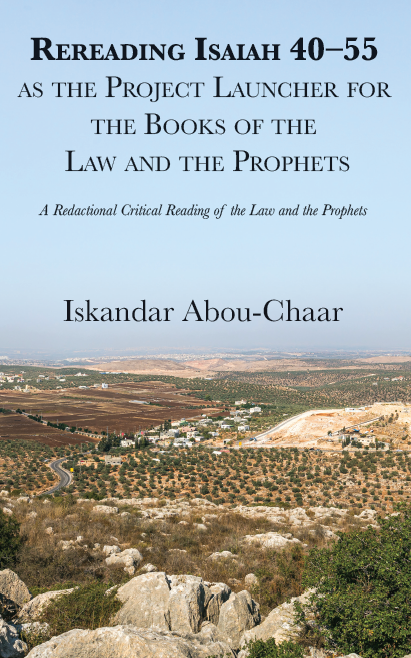
From Professor Iskandar Abou-Chaar

These words were uttered ten years ago by Professor Iskandar Abou-Chaar, one of the many presenters at Father Paul’s festschrift celebration of his fortieth teaching jubilee. Mr. Abou-Chaar sent it to Father Paul this morning from Beirut, Lebanon, as an attachment to an email in which he wrote:

Dear Father Paul,

You are always in our thoughts, and, most particularly, on the Jubilee of the first lecture you gave at Balamand. I attach the word I delivered at the 40th year Festschrift Banquet in NJ on Oct 23, 2010. I would repeat the same today.

With much love,
Iskandar

Exactly fifty years ago today, Monday, October 26 1970 (yes, even this day of the week), Fr. Paul Nadim Tarazi gave his first lecture at Balamand Seminary, marking the beginning of his incredible academic career.

Your Eminence, Reverend fathers, Colleagues and friends,

When I came to attend the first lecture to be given at the newly opened St. John of Damascus School of Theology in the fall of 1970, I had absolutely no idea about what to expect.

I had read a few weeks earlier in Lisan-ul-Hal newspaper an announcement about the opening of the institute. Through a series of unrelated circumstances, I decided to enroll in the opening class of that institute.

When I arrived to attend the first lecture, nothing had prepared me for what I saw. Tele Liban, the official Lebanese television were there with their cameras, officials in a representational capacity were there and entered the lecture room with chairs set for them on the side, the then director of the newly founded institute and Metropolitan of Latakia, his eminence Ignatius Hazim (now his beatitude patriarch Ignatius IV of Antioch) led the official representatives into the classroom and sat at their head to the side. The handful of students cowered in the middle of the room, and a young man with a goatee beard, a layman, stood in front of the intent gaze of the cameras, the officials, and the handful of students, center stage, and delivered the first lecture to be given at the newly founded institute. I had been told his name before the lecture, a Nadim Tarazi. We started hearing and taking notes.

When a few weeks later this lecturer entered the classroom clean-shaven, I barely noticed, except that he explained to the surprised students that now that we had become accustomed to seeing him lecture, we no longer needed the goatee beard as accreditation. For myself, my sense of sight had receded into the background since the first encounter. The input to my ears had proven to be more unexpected than the original scene. As with all sensory perception, the greater the impact of one sense, the more the others recede into the background—are drowned out. What followed the initial visual scene, became a series of audio encounters, with the sound of "Nadim" somehow attached to them.

The audio encounters would keep recurring, and seemed to arrange themselves under three major titles:

--The word trilectic would impress itself as one title. The scriptural deity was trilectic, not dialectic. The texts about Him would always require a "third" outside instance before they could be understood. This deity could not function as an ego, or superego, or alter-ego, He could not be made into a convenient bedfellow. He remains outside of our grasp, requiring a stranger for the encounter to take place. He is the judge, the impartial judge of our actions, outside our camp.

--The second recurring title concerned the only-begotten of this deity. He remains the slain lamb, the crucified lamb. He never becomes the Hero who leaves disgrace behind. It is the crucified Jesus who will ever be the judging Lord. His victory is on, never away from, the demeaning cross. He also remains paradoxically outside our camp, by our choice as the book of Revelation tells us. Who of us, after all, wishes to make his encampment and pitch his tent in a broken circle, with an encumbering stranger and a demeaning cross? The stranger knocks, who will open?

The corollary to that was in fact the content of the first lecture we had heard on that first day. The teacher of the Word of God/Gospel and by consequence the student, must die, must have death work in him, so that by consequence the student and thence the hearer may have life work in them, while his (the teacher's and by consequence the student's) life issues from the crucified Lord.

--The third recurring title concerns scripture. It is in the study of the scriptures, by day, preferably by night, that we can encounter the word of the nameless deity, the deity of the stranger, and the deity of the faceless and crucified slain lamb. The scriptures never give way to ethereal, timeless ideas. They are not a prison for the words. They, the scriptures, their syntax and their fabric, are the Word of God which must be studied again and again and again until the pages become yellow with use.

With the sound of the words, there was always a Nadim sound associated, and trying to understand the meaning of the word I made an astonishing discovery. In Arabic it sounded like someone who would spend with you the night till the early morning watch, sharing your cup and sorrows, and sharing with you his cup of consolation. But then you would meet a Swiss person, whether German, French or Italian, and it would mean the same thing in Swiss German, French or Italian, a Roumanian, and it would mean the same thing in Roumanian, an Englishman, a Russian, an Armenian, . . . and the series went on . . . , it meant the same in all those languages. And suddenly you realize, that when this Nadim was not spending the night with you sharing your cup, he was sharing the cup of someone else on the intervening nights, and on other nights filling up his cup of consolation by reading/studying scripture, so he would be able to share it with you and the others when he was sharing your/their cup.

So from the initial visual encounter, through the recurring audio encounters, the recollections finally give way to a prayer of thanks:

Thank you nameless Father, of the faceless and crucified Lamb, thank you for providing us with an earthenware vessel called Nadim, thank you for Abou-Jalal, thank you and Amen.

Mr. Abou-Chaar was a member of the first class of students at the St John of Damascus School of Theology at Balamand. At his graduation in 1974 he pursued further studies in scripture in Germany and Greece and became Father Paul’s colleague at that school as teacher of Old Testament, New Testament, Biblical Hebrew, and Biblical Greek for many years and served for one year as Interim Dean. Abou-Chaar’s breadth of knowledge accounts to a great degree to the information included in Father Paul’s monumental four volume Introduction to the New Testament. Three times he was the guest sole lecturer at the OCABS intensive five-day seminars in the 2000’s.
Decoding Genesis 1-11: A New Book by Paul Nadim Tarazi

Professor Tarazi's most recent book strongly advocates the authority of Scripture over all theology. Not shunning from being provocative as concerns the value of venerated translations and traditions, Tarazi shows the importance of studying the semantic nuances of the original consonantal Hebrew text of the Old Testament to discover the true face of God. Having read his book, the reader feels one great spiritual need: learn scriptural Hebrew!

Dr. Bartosz Adamczewski
Cardinal Stefan Wyszyński University in Warsaw

Thanks to Father Paul's linguistic and cultural skills, this volume is a unique gateway into the beauty of Genesis and the internal coherence of biblical literature. Jargon-free and thoroughly provocative, it is a treasure trove even for seasoned Bible readers. Reading Decoding Genesis 1-11 is like reading over the scribe's shoulder "In the beginning".

Dr. Philippe Guillaume
University of Berne (Switzerland)

BUY ON AMAZON

A Light in the Darkness: Bible Study for Children and Teens

A New Book by Bethany Saros

Through her faithful study of Scripture, Bethany shows how any layperson with the ability to read can teach children—even as the adults themselves are learning—while avoiding the pitfalls of interpretation and theological speculation. Teaching, she explains, is as simple as defining words, following the plot, identifying characters, looking up historical facts, and, most importantly, sticking to the text. Parents should read the stories of the Bible to their children without comment. “Narration,” Bethany explains, “teaches children submission to the story.” I hasten to add that her book challenges parents to do the same. That Bethany takes this directive seriously is evident in her insightful exegesis of various passages.

BUY ON AMAZON

For St. George's Day 2020

Repost from: https://lenapecathbob.livejournal.com/59333.html

Today is the Feast of St. George, a saint for whom I have both an academic and a personal attachment, a saint I suggest we very much need this year. Our need of and my fascination with St. George have nothing to do with George the martyred Roman soldier, whose life story was known as early as the 400s, but rather with what I’m quite sure is mythical: his famous dragon slaying. St. George was beside me through a year of cancer treatment four years ago precisely as dragon slayer, even though I’ve established in my research that story is not only legendary but non-Christian in origin: borrowed like so much else in Christianity (and Ancient Israelite religion before it) from “paganism.” George’s dragon slaying comes from the Canaanite stormgod Baal’s victory over Leviathan. The Greek historian John Malalas even says that Alexander the Great’s general Seleucus I offered sacrifices to the stormgod Zeus on Mount Zaphon, the home of Baal, on an April 23rd.

The dragon slaying is paramount precisely because it is myth. Myths combine imagery and poetry into a surplus of meaning that helps us venture further towards the inexpressible.

And in this case, what that myth of a monster-slaying saint addresses is suffering and the problem of evil. As Duke Divinity School professor Anathea Portier-Young writes (concerning the book of Daniel), while we do tend to see everything through a “myth of redemptive violence” and that has attendant dangers, cosmic conflict imagery is deep engagement with human suffering. St. George’s dragon slaying myth rejects the compromise on God’s goodness inherent in the platitude that “It must be God’s will somehow” for a child to die of COVID-19, in favor of a possible compromise on God’s omnipotence: as the Anglican theologian Andy Angel says, “foregoing some traditional ideas of God being in control of reality in the meantime in favor of the idea that forces of chaos (pictured in myth as [the dragon]) sometimes rage and that God [and his saint] battles against them.” Or, if you prefer a more secular version, as Evelyn Underhill wrote: “We see in this muddled world a constant struggle for Truth, Goodness, Perfection; and all those who give themselves to that struggle—the struggle for the redemption of the world from greed, cruelty, injustice, selfish desire and their results—find themselves supported and reinforced by a spiritual power which enhances life, strengthens will, and purifies character.”

Today’s world is worse than a muddle. Achille Mbembe, the Cameroon philosopher, blogged last week in “The Universal Right to Breathe,” “There is no doubt that the skies are closing in. Caught in the stranglehold of injustice and inequality, much of humanity is threatened by a great chokehold….COVID-19 is the spectacular expression of the planetary impasse in which humanity finds itself today.” The Corona Dragon is upon us all, albeit disproportionally, according to the ways we have divided and devalued each other. The horror of death, escorted by the dread of poverty from loss of work, and the terror of confinement for others. 

When I say we need a mythic hope, a St. George, I am not minimizing the need for we mortals to act—like the Ontario shopkeeper who bagged up a supply of food for the shoplifter he nabbed—nor the longer-term enterprise ahead building solidarity and dismantling what Mbembe calls “a vicious partitioning of the globe…the destruction of the biosphere…the criminalizing of resistance, repeated attacks on reason.” But when those who know what they are talking about advise us to do as little as possible right now, I’d suggest an appeal to St. George—again, to quote Mbembe, not “so much against a specific virus as against everything that condemns the majority of humankind to a premature cessation of breathing.” 

And one final reason to invoke St. George today, with Ramadan beginning tomorrow. St. George enfolds Muslims, as well, under his title of Khidr. (Jews, too, as Khidr is also Elijah, but we won’t get into that.) Today is the feast of Khidr for Sunni Muslims in Turkey; in the Crimea and Azerbaijan today marks Hıdırellez, the day on which Khidr and Elijah met on the earth. “Khidr” means “Green One,” the discoverer of the Water of Life in the Alexander Romance, and so the Turkish EMS is called “Khidr-Service.” There’s even a story of a Turkish soldier calling on Khidr during the Korean War and being saved from capture by the Chinese. Not a bad idea, then, for any of us. 

I’ve an icon of St. George over my front door—a common sight at Palestinian Christian homes, too—as well as a St. George sweatshirt my wife got me during chemo. Today, they’re helping me remember the dragonslayer whose day it is.